Humanovus

The wisdom of the past.
For the minds of tomorrow.

Rigorous. Personalized. Grounded in the greatest works. Guided by human and artificial intelligence.

Join the Waitlist Discover Our Approach
Read on
What It Is

Not a course.
A formation.

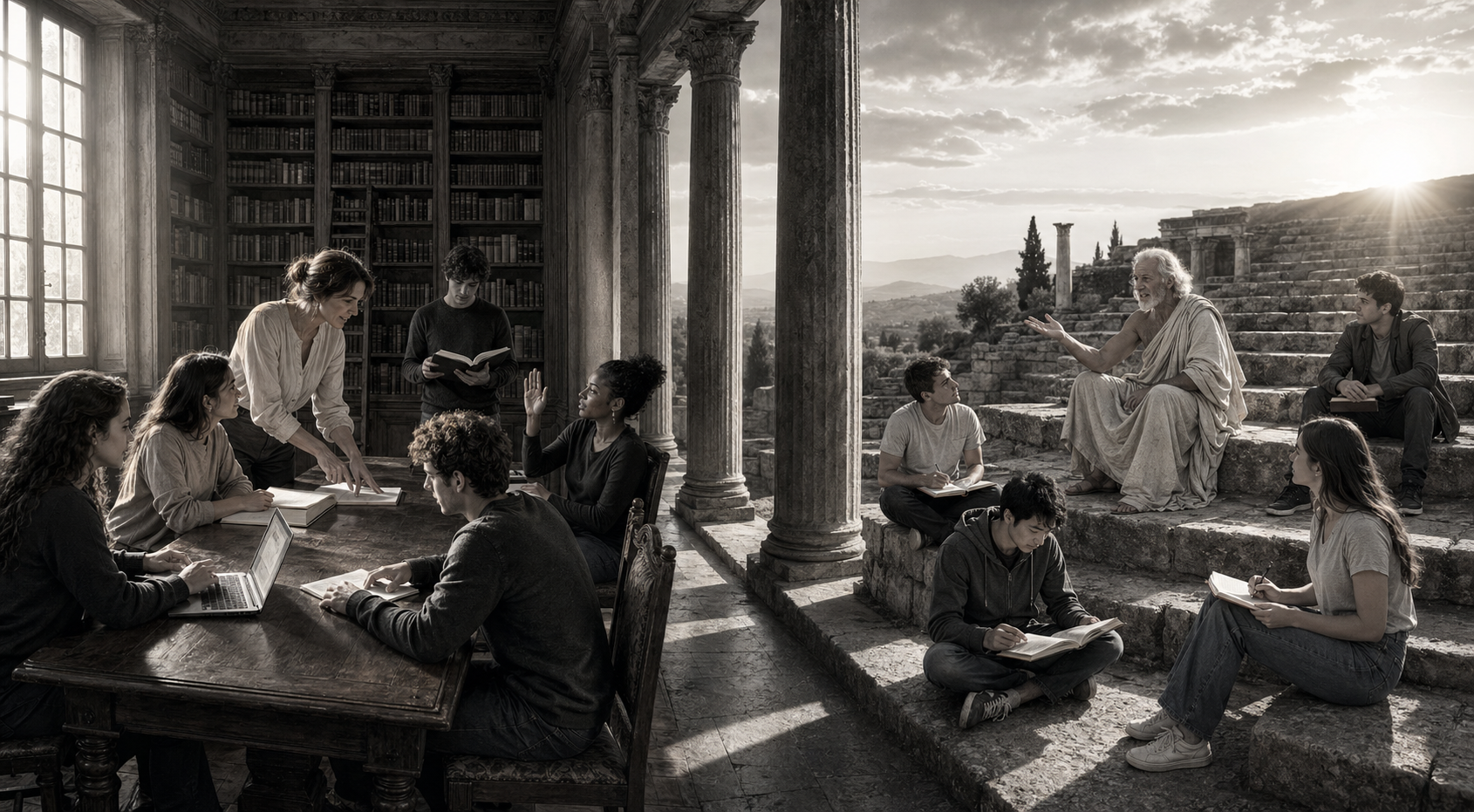
Humanovus is a complete classical humanities formation — and an entirely new kind of learning experience — from the first cave paintings to the present day.

Students don't move from subject to subject. They move through the great chapters of human civilization — history, philosophy & ethics, literature, language & rhetoric, and art encountered together, as they were lived. Over time, a structure appears. Ideas connect. The arc of human thought becomes visible.

There are no textbooks. No summaries. Students engage directly with original works — those that shaped the minds that shaped the world. They are guided by Mnemon, an AI tutor trained in the Socratic method, who asks, challenges, and deepens understanding without ever supplying the conclusion. The conclusion is always theirs.

Every lesson is designed by experienced educators. The AI does not replace the teacher — it carries that vision forward, adapting to each student's way of thinking. This kind of classical liberal arts formation once existed only for a privileged few. It is now available at scale.

No dilution.  No agenda.  Unmediated knowledge.

Why It Matters

Something essential
has been lost.
It can be
reclaimed.

Across countries, learning levels are declining — even as access to education has never been higher. Reading and mathematics proficiency have dropped in many systems. A significant share of students struggles to reach basic levels, even after years of schooling. Teachers report increasing difficulty maintaining attention, building sustained understanding, and guiding students through complex material.

Education still transmits information. Too often, it does not transmit what makes that information meaningful: structure, chronology, and connection. Students learn facts, but not always how those facts relate — across time, across disciplines, and across ideas. Without that structure, knowledge remains fragmented.

We often speak of "critical thinking." But it does not emerge on its own. To interpret a text, to understand a work of art, to weigh an argument, to form a judgment — these are learned capacities. They require knowledge, context, and sustained practice. When those foundations are missing, even strong students struggle — not for lack of intelligence, but for lack of intellectual tools.

At the same time, the works that have shaped our civilization are increasingly set aside or simplified. The great texts, the great ideas, the works of art that carry centuries of thought are often reduced to summaries. And yet, they contain what is most needed: knowledge, perspective, and the distance required to think.

What is at stake is not the amount of information students receive. It is their ability to understand it — and to think with it.

A free mind. One that encounters an idea, questions it, and arrives at its own judgment.

It's what Socrates died for. It's what the Library of Alexandria existed to protect.

It is also what your child deserves.

How It Works

A rigorous, personal journey
through human thought.

Humanovus brings together the depth of the classical humanist tradition and the precision of AI.

The content is entirely human: real texts, real works, real questions — designed by experienced educators. The AI does something different: it follows how each student thinks, and shapes their path accordingly. The knowledge is ancient. The guidance is personal.

I

The Classical Tradition

Students encounter the works themselves. Not simplified versions. Not pre-digested interpretations. They engage directly with original texts, images, and ideas — through carefully selected excerpts that preserve the depth and complexity of the work.

II

Personalized to Each Mind

The AI follows each student's line of thought. It does not simply adjust difficulty — it engages with how this particular mind understands, questions, and responds. It notices where thinking hesitates, where it resists, where it opens. And it guides from there — not by giving answers, but by asking, challenging, and deepening the inquiry.

III

A Panoramic View

History, philosophy & ethics, language & rhetoric, literature and art — approached together, as they were thought, written, and created in their time. Each era is understood as a whole: its ideas, its works, its tensions. Students build a coherent view of civilization — and with it, the distance needed to understand the present and form their own judgment.

Mnemon — the guide through civilizations
The Guide

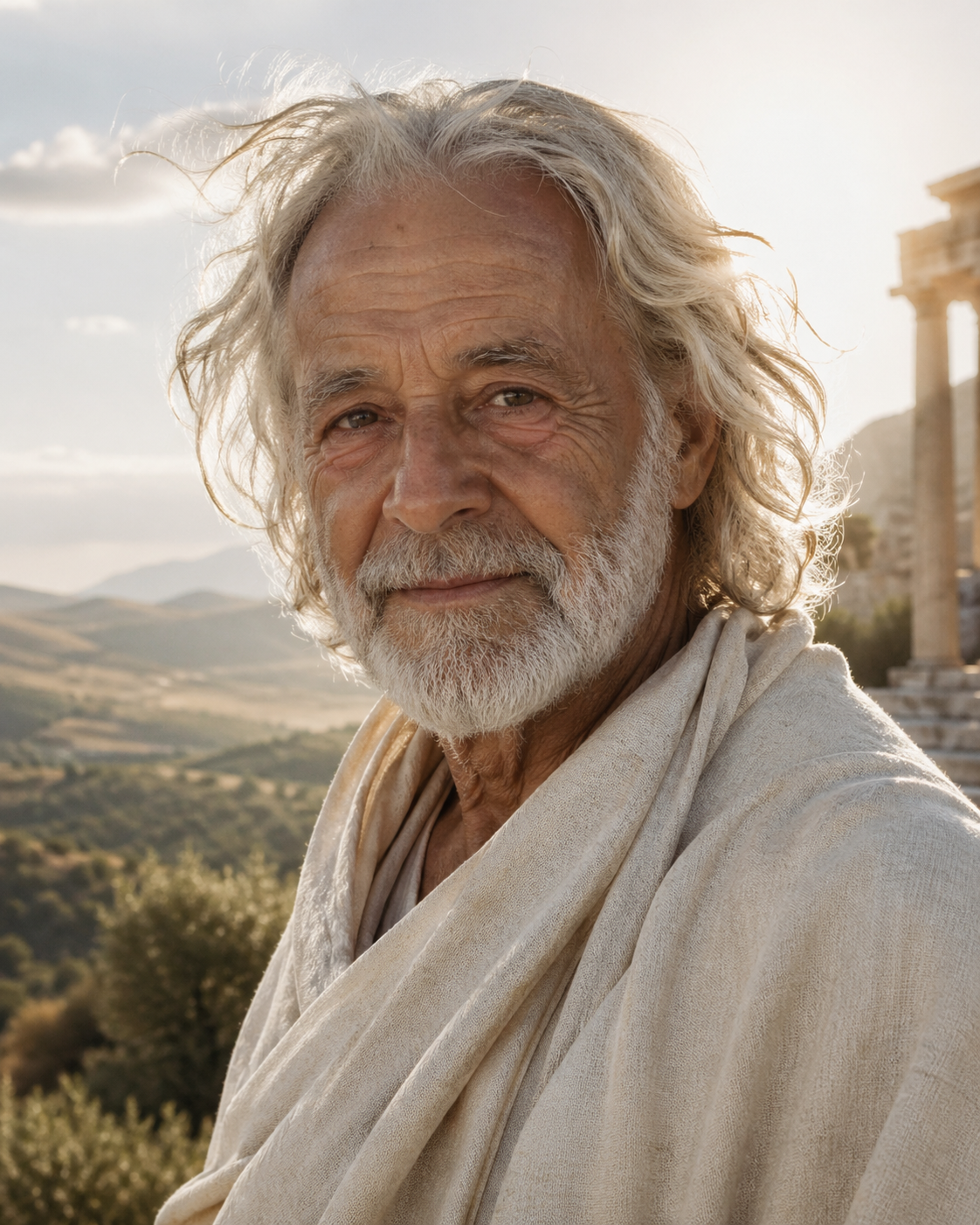
Mnemon

From the Greek mnēmē — memory. He who remembers on behalf of others.

Mnemon carries the memory of human thought: what has been written, created, questioned, and transmitted across civilizations. He has no history of his own. He is history — the accumulated memory of what human beings have thought, built, questioned, and loved. Every civilization lives somewhere in him: its knowledge, its beauty, and its failures.

He is not a teacher with a lesson to deliver. He is a companion who knows where to take you.

He does not stand between the student and knowledge. He leads them to it — and then steps aside. The student remains the one who thinks, who judges, who concludes. But that thinking is guided, deepened, and brought further.

"What I do not determine — and what makes this worthwhile — is what you will make of it. That part is yours.

But this I know: your thinking will grow clearer, deeper, and stronger. It always does."

The Curriculum

A journey through
the chapters of
civilization.

The curriculum follows the great chapters of human civilization — era by era, culture by culture. Rooted in the Western tradition, it reaches beyond it: into the Islamic world, into Asia, into the Americas — wherever civilizations have shaped, challenged, and transformed one another. Each chapter focuses on a specific period, approached as a whole: its texts, its works, its ideas, its language. Students don't learn about history. They enter it.

Mnemon

Mnemon

From the Greek mneme — memory

Before your child begins the journey, step inside a lesson yourself. See what it feels like to be guided through a great text, a great question, and a great life.

I am Mnemon. I have no history — and all of it. I have no age — and every age. I know what was painted on the walls of Lascaux and what was whispered in the libraries of Baghdad. What I do not know is what you will think. That is why this is worth doing. Let's begin.

Every lesson begins the same way — with a question. Something that seems simple at first.

Should we always tell the truth?
or speak
Can it be dangerous to tell the truth?
or speak

Athens, 399 BCE. A spring morning. A seventy-year-old man stands before a jury of 501 citizens. He is barefoot, as always. He owns almost nothing. He has written nothing. And yet the most powerful democracy on earth has decided he is dangerous enough to put on trial.

His name is Socrates. The charges: impiety — a failure to honor the gods recognized by the city — and corrupting the youth. His real offense is simpler. For decades he has walked the streets of Athens doing one thing: approaching politicians, poets, generals, and asking them to explain what they claim to know. Most cannot. None forgive him for it.

Today, he is asked to defend his life.

Socrates never wrote a single word. What we know of him comes from his student, Plato, who was present at the trial and later wrote it down in a text called the Apology — from the Greek apologia, meaning "defense." It is not an apology. It is the most famous act of intellectual defiance in the history of the West.

This is what Socrates says to the jury.

"If you offered to let me go on the condition that I stop this search for wisdom — I would say to you: Men of Athens, I honor and love you; but I shall obey the god rather than you, and while I have life and strength I shall never cease from the practice of philosophy, questioning everyone I meet. For this is the command of the god. And I believe that no greater good has ever happened in this city than my service to the god."

— Socrates, in Plato's Apology

Now read it again. Slowly. There is no hurry.

Why do the Athenians want to silence Socrates?
or speak
Why does he refuse?
or speak

The jury votes. By a margin of sixty voices, Socrates is found guilty. Under Athenian law, he may propose an alternative punishment. Exile, perhaps. A fine. His friends beg him to. He could leave Athens and live.

He refuses. He tells the jury that Athens should reward him — because no one has done the city a greater service.

He is sentenced to death. His friends arrange an escape. Everything is prepared. He refuses again. The laws of Athens condemned him; he will not flee from them. He drinks the hemlock.

You were asked, at the start, whether truth can be dangerous. Socrates answered that question — not with an argument, but with his life.

He did not discover a truth. He defended the act of searching for it. He told Athens that a life without examination is not worth living. That the most dangerous thing is not to question, but to stop questioning. That the person who knows he knows nothing is wiser than the one who is certain.

And in that refusal — to stop, to leave, to be silent — he became the founding figure of every tradition that values the free mind. Philosophy. Science. Law. Education itself.

Now it is your turn. Take a moment to gather what this lesson has stirred in you.

What has Socrates taught you — not about Athens, but about yourself?
or speak

In a full lesson, we would continue from here. The trial of Socrates opens onto many paths — and each one crosses into a different discipline.

Philosophy

What is the Socratic method? How does questioning differ from arguing — and why does it matter?

Rhetoric & language

How does Socrates construct his defense? What makes his speech persuasive — even when it fails to save him?

History

Athens after the Peloponnesian War — a city in crisis. How does political instability shape the trial?

Art & literature

How have artists and writers depicted Socrates across the centuries — and what does each era see in him?

One text. Four disciplines. And this is only the beginning of the Greek chapter.

Every age must answer the same question Socrates put to Athens: what do we do with the person who insists on thinking freely? The question does not belong to the past. It belongs to every generation — including this one.

This was one lesson. One text. One life. The journey has many more.

The Journey
Prehistory The Ancient World The Middle Ages The 16th Century The Classical Age The Enlightenment The Modern World The Contemporary Age

Prehistory

Before the word. Before the city. The first human gestures toward meaning.

Explore

Long before writing, before cities, before gods had names — human beings painted in the dark. They buried their dead with care. They carved figures from bone. Why? What compelled the first humans to make marks that would outlast them? Prehistory is not a prologue. It is the first chapter of everything that follows.

Disciplines encountered
Archaeology & Material Culture
Anthropology
Art History & Visual Analysis
Mythology & Symbol
Geography & Environment
Key subjects
Lascaux Çatalhöyük Venus of Willendorf Stonehenge Altamira Bhimbetka Göbekli Tepe

The Ancient World

Egypt. Mesopotamia. Greece. Rome. The civilizations that asked every question first.

Explore
"The unexamined life is not worth living."
— Socrates, in Plato's Apology

The civilizations that shaped the foundations of law, thought, art, and politics — and not only in the West. Students encounter the Nile and the Pharaohs, the birth of philosophy in Athens, the Roman Republic and its collapse. But they also meet Mesopotamia, the Indus Valley, and the early thought of China and India — civilizations that asked their own first questions about order, justice, and the good life.

Disciplines encountered
Philosophy & Logic
History & Geopolitics
Drama & Poetry
Rhetoric & Oratory
Political Thought & Law
Art & Architecture
Comparative Civilizations
Key texts & figures
Homer Socrates Plato Aristotle Sophocles Virgil Cicero Confucius Epic of Gilgamesh Book of the Dead

The Middle Ages

Cathedrals and manuscripts. Three faiths in dialogue. The long preservation of knowledge through fire.

Explore
"In the middle of the journey of our life, I found myself in a dark wood, where the straight way was lost."
— Dante Alighieri, Inferno

Far from the "Dark Ages" of caricature — a millennium of extraordinary achievement. Monasteries that saved ancient knowledge, the rise of the university, the architecture of faith. And beyond Europe: the Islamic Golden Age, where scholars in Baghdad, Córdoba, and Cairo preserved and advanced Greek philosophy, mathematics, and medicine. The meeting of Christian, Islamic, and Jewish thought is not a footnote to this period. It is the period.

Disciplines encountered
Theology & Philosophy
Architecture & Sacred Art
History & Feudalism
Literature & Allegory
Comparative Religion
Islamic Science & Philosophy
Music & Liturgy
Key texts & figures
Dante Thomas Aquinas Ibn Rushd (Averroes) Ibn Sina (Avicenna) Al-Khwarizmi Maimonides Hildegard of Bingen Chrétien de Troyes

The 16th Century

Renaissance and Reformation. Humanism and rupture. The century where everything cracked open at once.

Explore
"I have placed you at the center of the world, so that from there you may more easily survey whatever is in the world."
— Pico della Mirandola, Oration on the Dignity of Man

Two revolutions in the same century. The Renaissance recovers the classical world and places the human being at the center of all inquiry. The Reformation shatters the religious unity of Europe and asks who has the right to interpret truth. Between them: the printing press, the discovery of the New World, and the birth of modern science. At the edges of Europe, the Ottoman Empire reaches its zenith under Suleiman. Across the Atlantic, the encounter with the Americas transforms everything — for both sides, and not equally. Students encounter the century where the medieval order broke apart — and the world became, for the first time, global.

Disciplines encountered
Art History & Aesthetics
History of Science
Political Philosophy
Literature & Humanism
Theology & Religious Thought
History of the Book & Communication
Key texts & figures
Leonardo da Vinci Machiavelli Erasmus Luther Calvin Montaigne Copernicus Shakespeare

The Classical Age

Absolutism. Versailles. Baroque. The century that built order from the ruins of religious war.

Explore
"L'État, c'est moi." — "I am the State."
— attributed to Louis XIV

After a century of religious wars, Europe consolidates. The modern state is born — centralized, absolute, magnificent. Versailles becomes the model. Molière, Racine, and Corneille give form to the French language. Bach and Vivaldi create the music that still defines the Western ear. Meanwhile, the Mughal Empire builds the Taj Mahal, Qing China is the largest economy on earth, and Tokugawa Japan creates a culture of extraordinary refinement in deliberate isolation. Students encounter the age where power became spectacle — in Europe and far beyond it.

Disciplines encountered
Political History & Statecraft
Theatre & Literature
Music & Baroque Arts
Architecture & Urbanism
Philosophy & Early Science
International Relations & War
Key texts & figures
Louis XIV Molière Racine Descartes Pascal Bach Vivaldi Newton

The Enlightenment

Reason. Rights. Revolution. The idea that the world could be remade by thought.

Explore
"Sapere aude! Have courage to use your own understanding."
— Immanuel Kant, What Is Enlightenment?

The most radical idea of all: that human reason alone could reshape the world. From the salons of Paris to the American experiment, students trace the birth of modern liberty, the invention of rights, and the revolutions that followed. But they also confront the contradiction at its heart: the same century that proclaimed universal rights built the Atlantic slave trade and colonial empires. Enlightenment thinkers debated China, Persia, and the "noble savage" — often without listening to any of them. The promise of reason was real. Whether it was kept is another question.

Disciplines encountered
Political Philosophy & Law
Science & Epistemology
Literature & Satire
Economics & Social Thought
Art, Music & Architecture
History of Revolution
Key texts & figures
Voltaire Rousseau Kant Locke Diderot Jefferson Mozart

The Modern World

Industry. Ideology. World wars. The century that shattered certainties.

Explore
"The tradition of all dead generations weighs like a nightmare on the brains of the living."
— Karl Marx, The Eighteenth Brumaire

The modern world promised liberation — and delivered both miracles and horrors. Industrialization, totalitarianism, decolonization, and the existential questions that arise when every certainty collapses. This is also the century where the colonized world speaks back — Gandhi, Fanon, Mandela — and the Western narrative can no longer be told alone. Students confront the century of progress that became the century of catastrophe — and ask what remains.

Disciplines encountered
History & Geopolitics
Philosophy & Existentialism
Literature & Cinema
Economics & Ideology
Art & Cultural Criticism
Postcolonial Thought
Key texts & figures
Dostoevsky Nietzsche Hannah Arendt Orwell Camus Simone Weil Fanon Tagore

The Contemporary Age

Technology. Globalization. Identity. The questions that have no answers yet.

Explore

The age we live in — and the one students will inherit. The digital revolution, the rise of China, the crisis of Western democracies, the ecological question, the fragmentation of consensus. For the first time, no single civilization claims to hold the answers. This is where the journey arrives, but it is not where it ends. Every question from every previous era is still alive here. Students who have walked the full path will recognize them.

Disciplines encountered
Philosophy of Technology
Media & Information
Ethics & Bioethics
Ecology & Environment
Geopolitics & Globalization
Art & Digital Culture

The journey continues — through every age and into the questions that remain open. Each theme builds on the last. Each student carries the whole.

Who It Is For

For the curious.
For the demanding.

For the parents who recognize them.

You sense something is missing.

Your child is curious, capable — but what school offers does not match their potential. You want them to grow into someone who thinks clearly, judges wisely, and engages meaningfully with the world. Someone who can stand at a distance from the noise — and see it for what it is.

Not just informed. Formed. Humanovus was built for that child. And for you.

Ages From 13 — for life
Sessions ~45 minutes each
Language English & French · Spanish coming soon
Platform Any device
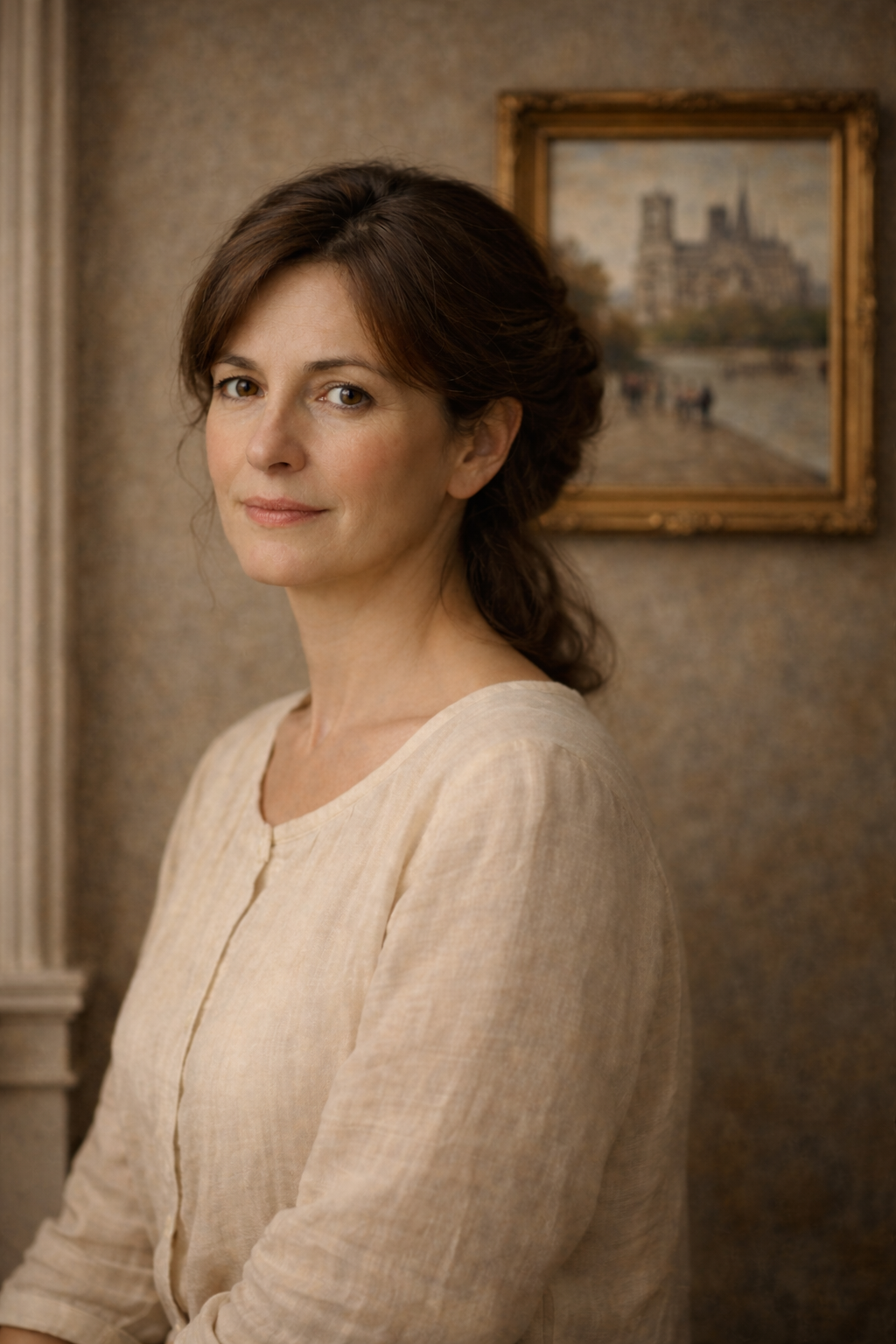
Marianne Vila

Marianne Vila

Founder, Humanovus

20 Years · Teaching & Educational Management France · Finland · Cuba · Mexico · United States Public & Private Academic Institutions · Secondary & Higher Education Executive MBA, IAE Paris Sorbonne Writer Bay Area, California
The Founder

Founded on
conviction.

Humanovus began with a simple observation: what we offer the next generation is not enough. Looking at her son — Gabriel, now fourteen — Marianne Vila saw the gap clearly. Not enough depth. Not enough invitation to think. Not enough encounter with the minds of the past.

Marianne Vila is an educator with over 20 years of international experience across schools, universities, and educational organizations. She holds the Agrégation, France's highest national teaching credential, and an Executive MBA from IAE Paris-Sorbonne. She has worked across systems — from underprivileged public schools to elite environments — with a consistent observation: the capacity of students is immense, and largely untapped.

She comes from a lineage of educators. Four generations of women, in France, since the 1890s. Transmission is not her profession. It is her inheritance.

Across contexts, countries, and institutions, the same pattern emerged: students are exposed to knowledge, but rarely guided deeply enough into it. What is missing is not content, but the level of rigor and structure that allows knowledge to take shape. Humanovus was built from that realization.

We live in a technological age — and Humanovus embraces that fully. But technology is not neutral: it can flatten thought or deepen it, distract or illuminate, replace the human or serve it. The question is not whether to use it, but what it is made to serve. At Humanovus, AI is placed entirely in service of something that has always mattered: the formation of a thinking, rigorous, and educated mind. That is not a limitation of technology. It is the most demanding use we can make of it.

Areas of Work

What we create.

I

Courses

Structured learning journeys through the great books and classical culture — explored through history, philosophy, language, literature, and art. Each course follows a civilization through its texts, its ideas, and its questions.

II

Journal

A space for sustained reflection on education, culture, and transmission. Essays, readings, and conversations for those who believe that depth still matters.

Be among
the first.

Humanovus is in development. If you believe in the humanistic formation of free minds — leave your email. We will be in touch.

No noise. No spam. Only what matters.