Humanovus
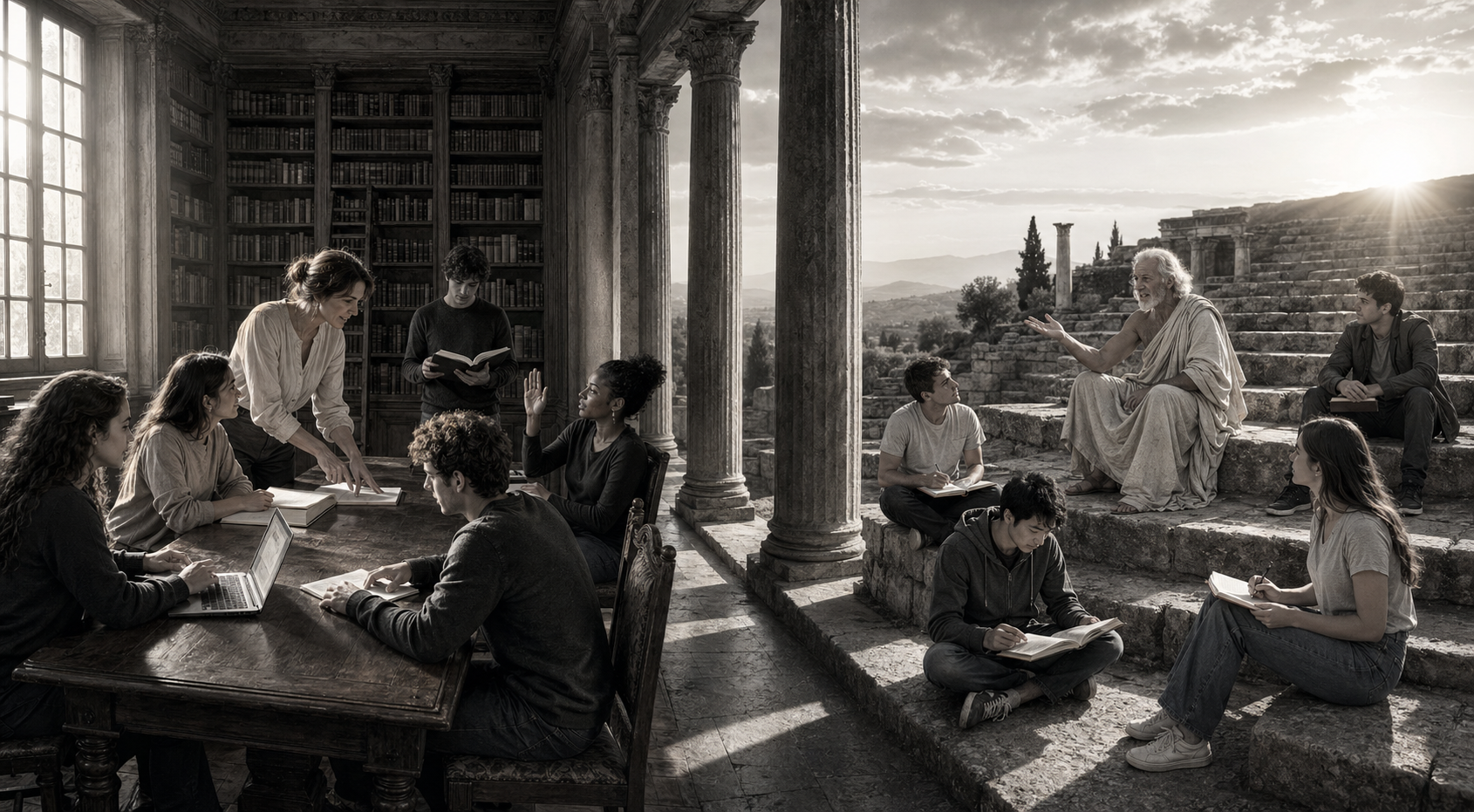
A rigorous humanistic formation: the method, the great works. For teenagers and adults.
Educators and a Socratic AI to guide you.
The Method and the first journey (The Ancient World) open September 2026.
Cette page est disponible en français →
For three centuries, the French tradition has taught a specific intellectual discipline: how to read a source closely, how to build an argument, how to write with structure, how to defend a position aloud.
Few formations shape a mind as fully: it teaches clear thinking, structured writing, and the capacity to hold a position without mistaking it for a mood.
Humanovus brings it back — self-paced, for anyone willing to do the work.
Four modules.
Opens September 2026.
Our heritage:
art · literature · history · philosophy
studied by period,
from Prehistory to the contemporary world.
Original sources, analysis, Socratic dialogue with Mnemon.
Walk the full arc, or begin with the period of your choice.
The Ancient World opens September 2026.
— Marianne Vila, founder Read the full letter →"I taught for twenty years — from neighborhood middle schools to elite high schools, from public universities to private higher education, across France, Finland, Mexico, and the United States. Everywhere, I saw the same thing: students capable of far more than what was asked of them. What is missing is not content. It is depth. Humanovus is my attempt to return it."
The great works demand time, and time is short. Curricula have thickened, classes have grown, the rhythm has accelerated. It is not the fault of teachers, nor of students — it is the era. Humanovus opens a space where slow work becomes possible again.
Students today are asked to produce — essays, presentations, analyses — without always being taught the disciplines that make production rigorous. The method exists. It is transmissible. It can be learned at any age.
AI can write for you. It can also think with you — if it is built for that.
Mnemon is built for that. He questions, pushes back, refuses weak reasoning.
AI is not the threat. Shallow thinking is. Humanovus uses AI to restore depth, not to replace it.
Question. Source. Reflection. Dialogue.
Each session opens with a question drawn from the period under study — one with no obvious answer, requiring the student to examine their assumptions before proceeding.
A carefully selected excerpt from an original work — a philosopher's argument, a passage of literature, a historical document, a work of art — presented without simplification or summary.
The student writes a short analysis: a first interpretation, a judgment, a question of their own. Writing is the instrument of thought — not a simple test.
Mnemon reads the response and asks a sharper question. The exchange continues — pressing where reasoning is incomplete — until the thinking deepens or a new question opens.
Both tracks follow the same structure. The sources, the scaffolding, and the demands adapt to the level.
He holds the memory. You do the thinking.
From the Greek mnémè — memory
Mnemon carries the memory of human thought: what has been written, created, questioned, and transmitted across civilizations. He has no history of his own. He is history — the accumulated memory of what human beings have thought, built, questioned, and loved. Every civilization lives somewhere in him: its knowledge, its beauty, and its failures.
He is not a teacher with a lesson to deliver. He is a guide who knows where the questions lead.
He does not stand between the student and knowledge. He leads them to it — and then steps aside. The student remains the one who thinks, who judges, who concludes. But that thinking is guided, deepened, and brought further.
"What I do not determine — and what makes this worthwhile — is what you will make of it. That part is yours."
He does not replace the teacher, the book, or the student. He accompanies — and he demands.
The curriculum traces the great ages of history — era by era, across the civilizations that have shaped human thought. Each period is approached as a whole: its texts, its works, its ideas, its language. Students don't learn about history. They enter it.
Built by experienced educators. Every era, every source, every question chosen with care.
Step inside a lesson. Socrates has been condemned. He has one last question for you.
"I didn't know philosophy could be about real things. I wanted to keep going." — Gabriel, 14
This is a lesson excerpt — approximately 10 to 15 minutes.
I am Mnemon. I have no history — and all of it. I have no age — and every age. I know what was painted on the walls of Lascaux and what was whispered in the libraries of Baghdad. What I do not know is what you will think. That is why this is worth doing. Let's begin.
Every lesson begins the same way — with a question. Something that seems simple at first.
Athens, 399 BCE. A spring morning. A seventy-year-old man stands before a jury of 501 citizens. He is barefoot, as always. He owns almost nothing. He has written nothing. And yet the most powerful democracy on earth has decided he is dangerous enough to put on trial.
His name is Socrates. The charges: impiety — a failure to honor the gods recognized by the city — and corrupting the youth. His real offense is simpler. For decades he has walked the streets of Athens doing one thing: approaching politicians, poets, generals, and asking them to explain what they claim to know. Most cannot. None forgive him for it.
Today, he is asked to defend his life.
Socrates never wrote a single word. What we know of him comes from his student, Plato, who was present at the trial and later wrote it down in a text called the Apology — from the Greek apologia, meaning “defense.” It is not an apology. It is the most famous act of intellectual defiance in the history of the West.
This is what Socrates says to the jury.
Athens, 399 BCE. A spring morning. A seventy-year-old man stands before a jury of 501 citizens. He is barefoot, as always. He owns almost nothing. He has written nothing. And yet the most powerful democracy on earth has decided he is dangerous enough to put on trial.
His name is Socrates. The charges: impiety — a failure to honor the gods recognized by the city — and corrupting the youth. His real offense is simpler. For decades he has walked the streets of Athens doing one thing: approaching politicians, poets, generals, and asking them to explain what they claim to know. Most cannot. None forgive him for it.
Athens is not at its best. The Peloponnesian War ended five years ago in humiliating defeat to Sparta. The democracy was briefly overthrown by the Thirty Tyrants — a brutal oligarchy backed by Sparta — before being restored. The city is shaken, suspicious, and looking for people to blame.
Today, Socrates is asked to defend his life.
Socrates never wrote a single word. What we know of him comes from his student, Plato, who was present at the trial and later wrote it down in a text called the Apology — from the Greek apologia: a defense, not an expression of regret. It is the most famous act of intellectual defiance in the history of the West.
This is what Socrates says to the jury.
"If you offered to let me go on the condition that I stop this search for wisdom — I would say to you: Men of Athens, I honor and love you; but I shall obey the god rather than you, and while I have life and strength I shall never cease from the practice of philosophy, questioning everyone I meet. For this is the command of the god. And I believe that no greater good has ever happened in this city than my service to the god."
— Socrates, in Plato's ApologyNow read it again. Slowly. There is no hurry.
The jury votes. By a margin of sixty voices, Socrates is found guilty. Under Athenian law, he may propose an alternative punishment. Exile, perhaps. A fine. His friends beg him to. He could leave Athens and live.
He refuses. He tells the jury that Athens should reward him — because no one has done the city a greater service.
He is sentenced to death. His friends arrange an escape. Everything is prepared. He refuses again. The laws of Athens condemned him; he will not flee from them. He drinks the hemlock.
The jury votes. By a margin of sixty voices, Socrates is found guilty. Under Athenian law, he may propose an alternative punishment. Exile, perhaps. A fine. His friends beg him to. He could leave Athens and live.
He refuses. He tells the jury that Athens should reward him — because no one has done the city a greater service.
He is sentenced to death. His friends arrange an escape. Everything is prepared. He refuses again. The laws of Athens condemned him; he will not flee from them. He drinks the hemlock.
A question lingers here that is easy to miss: Socrates accepts the verdict of a system he believes is wrong. He refuses to escape, because the laws must be respected — even when they produce an unjust result. He makes a distinction between the law and its application.
Socrates could have left. He chose to die. His argument was that fleeing would undermine the very principles he had spent his life defending.
But there is another way to read this: by dying, Socrates becomes a martyr. His death ensures that his ideas survive. Plato writes the Apology. Twenty-four centuries later, you are reading it.
You were asked, at the start, whether truth can be dangerous. Socrates answered that question — not with an argument, but with his life. He did not discover a truth. He defended the act of searching for it. He told Athens that a life without examination is not worth living. That the most dangerous thing is not to question, but to stop questioning. That the person who knows he knows nothing is wiser than the one who is certain. And in that refusal — to stop, to leave, to be silent — he became the founding figure of every tradition that values the free mind. Philosophy. Science. Law. Education itself.
Now it is your turn. Take a moment to gather what this lesson has stirred in you.
In a full lesson, we would continue from here. The trial of Socrates opens onto many paths — and each one crosses into a different discipline.
What is the Socratic method? How does questioning differ from arguing — and why does it matter?
How does Socrates construct his defense? What makes his speech persuasive — even when it fails to save him?
Athens after the Peloponnesian War — a city in crisis. How does political instability shape the trial?
How have artists and writers depicted Socrates across the centuries — and what does each era see in him?
One text. Four disciplines. And this is only the beginning of the Greek chapter.
What you've just experienced is an excerpt — not the full lesson.
In a full Humanovus lesson:
This was a taste. The real experience goes further.
Socrates defended something specific: not a truth, but the act of searching for truth. He argued that a life without examination is not worth living — and then proved it by dying rather than stopping.
In a full lesson, we would continue from here. The trial of Socrates opens onto many paths — and each one crosses into a different discipline.
What is the Socratic method? How does questioning differ from arguing — and why does it matter? What is the relationship between Socrates' method and his fate?
How does Socrates construct his defense? The Apology is a masterwork of persuasion — one that fails to save his life but succeeds in everything else. How? And what do the words themselves reveal — their origins, their structure, their evolution across centuries?
Athens after the Peloponnesian War — a democracy in crisis, haunted by the betrayal of its own elites. How does political trauma shape who a society chooses to punish?
From David's Death of Socrates to Raphael's School of Athens — how have artists and writers depicted this moment across the centuries, and what does each era see in him?
One text. Four disciplines. And this is only the beginning of the Greek chapter.
What you've just experienced is an excerpt — not the full lesson.
In a full Humanovus lesson:
This was a taste. The real experience goes further.
Every age must answer the same question Socrates put to Athens: what do we do with the person who insists on thinking freely? The question does not belong to the past. It belongs to every generation — including this one.
This was one lesson. One text. One life. The journey has many more.
Long before writing, before cities, before gods had names — human beings painted in the dark. They buried their dead with care. They carved figures from bone. Why? What compelled the first humans to make marks that would outlast them? Prehistory is not a prologue. It is the first chapter of everything that follows.
"The unexamined life is not worth living."— Socrates, in Plato's Apology
The civilizations that shaped the foundations of law, thought, art, and politics — and not only in the West. Students encounter the Nile and the Pharaohs, the birth of philosophy in Athens, the Roman Republic and its collapse. But they also meet Mesopotamia, the Indus Valley, and the early thought of China and India — civilizations that asked their own first questions about order, justice, and the good life.
"In the middle of the journey of our life, I found myself in a dark wood, where the straight way was lost."— Dante Alighieri, Inferno
Far from the "Dark Ages" of caricature — a millennium of extraordinary achievement. Monasteries that saved ancient knowledge, the rise of the university, the architecture of faith. And beyond Europe: the Islamic Golden Age, where scholars in Baghdad, Córdoba, and Cairo preserved and advanced Greek philosophy, mathematics, and medicine. The meeting of Christian, Islamic, and Jewish thought is not a footnote to this period. It is the period.
"I have placed you at the center of the world, so that from there you may more easily survey whatever is in the world."— Pico della Mirandola, Oration on the Dignity of Man
Two revolutions in the same century. The Renaissance recovers the classical world and places the human being at the center of all inquiry. The Reformation shatters the religious unity of Europe and asks who has the right to interpret truth. Between them: the printing press, the discovery of the New World, and the birth of modern science. At the edges of Europe, the Ottoman Empire reaches its zenith under Suleiman. Across the Atlantic, the encounter with the Americas transforms everything — for both sides, and not equally. Students encounter the century where the medieval order broke apart — and the world became, for the first time, global.
"L'État, c'est moi." — "I am the State."— attributed to Louis XIV
After a century of religious wars, Europe consolidates. The modern state is born — centralized, absolute, magnificent. Versailles becomes the model. Molière, Racine, and Corneille give form to the French language. Bach and Vivaldi create the music that still defines the Western ear. Meanwhile, the Mughal Empire builds the Taj Mahal, Qing China is the largest economy on earth, and Tokugawa Japan creates a culture of extraordinary refinement in deliberate isolation. Students encounter the age where power became spectacle — in Europe and far beyond it.
"Sapere aude! Have courage to use your own understanding."— Immanuel Kant, What Is Enlightenment?
The most radical idea of all: that human reason alone could reshape the world. From the salons of Paris to the American experiment, students trace the birth of modern liberty, the invention of rights, and the revolutions that followed. But they also confront the contradiction at its heart: the same century that proclaimed universal rights built the Atlantic slave trade and colonial empires. Enlightenment thinkers debated China, Persia, and the "noble savage" — often without listening to any of them. The promise of reason was real. Whether it was kept is another question.
"The tradition of all dead generations weighs like a nightmare on the brains of the living."— Karl Marx, The Eighteenth Brumaire
The modern world promised liberation — and delivered both miracles and horrors. Industrialization, totalitarianism, decolonization, and the existential questions that arise when every certainty collapses. This is also the century where the colonized world speaks back — Gandhi, Fanon, Mandela — and the Western narrative can no longer be told alone. Students confront the century of progress that became the century of catastrophe — and ask what remains.
The age we live in — and the one students will inherit. The digital revolution, the rise of China, the crisis of Western democracies, the ecological question, the fragmentation of consensus. For the first time, no single civilization claims to hold the answers. This is where the journey arrives, but it is not where it ends. Every question from every previous era is still alive here. Students who have walked the full path will recognize them.
Each period stands alone. Enroll in one, several, or the full arc. The first students will receive preferential pricing on all future journeys.
The journey continues — through every age and into the questions that remain open. Each theme builds on the last. Each student carries the whole.
For the teenager who wants more than what is asked of them — and for the parent who recognizes it.
For the adult who feels part of their formation was never finished, and who wants to return to it.
For the teacher who wishes they could offer their students what the classroom alone no longer allows.
For anyone who would rather think than skim.
Humanovus opens in September 2026 with The Method and the first journey: The Ancient World. The first cohort will be deliberately small — the first participants will be few and followed closely. If what you have read speaks to you, write to us. We reply personally.